
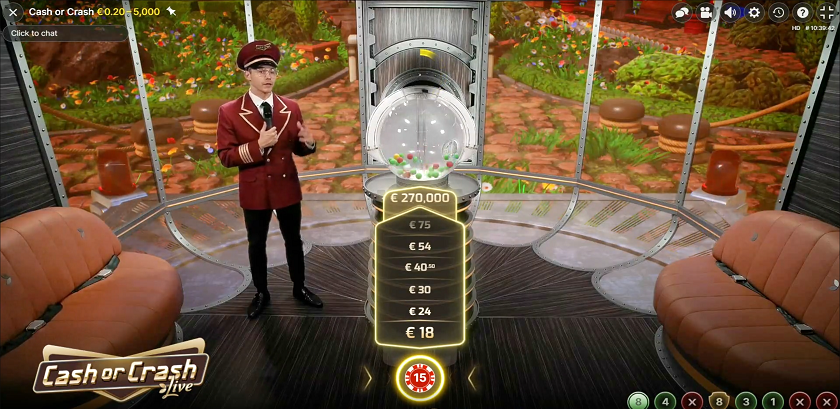
When we examine the inner workings of live game shows like Cash Or Crash Live Promo Code, we discover features intended to provide players a sense of influence within a high-risk environment. The Block feature shines as amongst the most key tactical tools available to UK players. In contrast to the core game of luck, where a random multiplier can crash at any time, the Block enables a player to proactively ‘lock in’ a share of their potential winnings before the inevitable crash happens. It changes a purely spectator experience into a more interactive, decision-based version. We see its use as a essential risk-mitigation approach, separating informal play from more thoughtful ways. For the UK market, where gambling is often viewed through a lens of both entertainment and astute engagement, becoming proficient in this function is key to managing the game’s built-in conflict between desire for more and protection.
Precisely what the Block Function Really Does
Fundamentally, the Block function in Cash or Crash Live is a basic but effective security measure. As a round progresses, as the multiplier increases, a user can press the Block button to guarantee a slice of their prospective winnings. This action sets a protected minimum for that round’s payout. If the round crashes at a multiplier lower than the point they set their block, they are still awarded the protected value. If it goes beyond the protection threshold, their potential winnings continue to grow, but the protected amount is secure. It’s crucial to understand that employing the Block does not conclude your play during that round; your current multiplier stays in play, yet you’ve got a safety cushion. We consider this dual-mode experience—being both safe and still in the game—as the function’s psychological hook. For UK players, it deals with the age-old problem of deciding when to cash out, an idea well-known from contexts as varied as stock trading and a nail-biting pub quiz.
Well-planned Timing for UK Participants
Strategic utilization of the Block revolves around pacing, and UK users commonly create habits according to observed gameplay patterns and own tolerance for risk. There exists no universally ideal point, which is what makes it a highly debated issue. Many recommend an first block, perhaps at a modest 1.5x or 2x multiplier, to guarantee a tiny but steady profit, accumulating a capital gradually and securely. Some, pursuing greater returns, will permit the multiplier go far higher before activating their block. Our research shows the fact that many seasoned users in the UK employ a combined method, modifying their block level depending on the pattern of recent games. As an illustration, after multiple consecutive low-multiplier crashes, a few could deploy earlier, expecting a trend. Conversely, upon a large multiplier, the subsequent session might see users blocking later, anticipating it happening again. The important thing is that the decision is proactive and context-driven, moving the player from a passive bystander to an active decision-maker, controlling their own risk.
Comparing Block to Auto-Cash-Out

It’s crucial to differentiate the Block function from the individual Auto-Cash-Out feature, as UK players at times conflate the two. Auto-Cash-Out is a set-and-forget tool where you set a multiplier at which your entire bet is immediately cashed out, ending your participation in that round fully. The Block function is more nuanced. It does not end your round; it simply secures a portion of your winnings while your live bet carries on to ride. This signifies you can still profit from a rising multiplier after blocking, which is not feasible with Auto-Cash-Out. We regard Auto-Cash-Out as a tool for discipline, enforcing a strict profit target. The Block, however, is a tool for risk management and opportunity maximisation. A sophisticated UK player might use both in tandem—for illustration, establishing a conservative Auto-Cash-Out at 10x but using a manual Block at 4x to guarantee a minimum profit well before that target.
Emotional Influence on Gameplay
The addition of the Block option dramatically changes the mental interplay of Cash or Crash Live. Without the Block, the game is a straightforward challenge of nerves, a binary “cash out or bust” scenario that commonly causes regret—caused by quitting too soon or crashing with nothing. The Block resolves this by providing a third, soothing choice. This feature alleviates the fear of total loss, which in turn can lead to calmer and more gainful decisions. We find that UK players using the Block often report feeling more in control, which increases their pleasure and involvement with the game. Nevertheless, it also introduces new forms of mental stress, such as the vexation of blocking at 3x only to see the multiplier increase to 10x. This “fear of missing out” (FOMO) is a strong driver, and learning to control the emotional response to a good or bad block is just as vital as getting the timing right.
Frequent Blocking Mistakes to Avoid
Through our analysis of gameplay, we’ve recognized several common pitfalls UK players should be aware of when using the Block. The most prevalent mistake is blocking out of panic at the first hint of a rising multiplier, often at a figure so low it barely pays for the initial stake. This defeats the function’s purpose of securing meaningful profit. Conversely, greed leads to the mistake of never blocking at all, treating every round as an all-or-nothing gamble, which statistically erases gains over time. Another subtle error is placing the block at a particular, psychologically important number like 5.0x, which many other players are also apt to use. If a crash is crafted to frequently occur just below such typical thresholds, this strategy can misfire. We advise players to change their block points and found them on a pre-defined strategy rather than emotional impulses during the heat of the round.
In what manner UK Rules Affect Feature Use
The use of features like the Block is not an isolated event; it is shaped by the UK’s stringent gambling regulations and responsible gaming framework. The UK Gambling Commission requires that games include transparent information and tools that promote player control. The Block function fits perfectly with this philosophy, as it is a practical tool for controlling risk and limiting losses. Furthermore, the availability of detailed game stats and history, which UK-licensed platforms are required to provide, directly contributes to Block strategy. Players can examine past rounds to optimize their timing, adding an analytical element to the game. It is also noted that the UK industry’s focus on transparency results in the workings of the Block are clearly explained, avoiding confusion. This framework of regulations encourages a more cautious, strategic mindset to the game, where the Block is regarded not just as a button, but as a central component of informed play.
Building a Custom Block Strategy
Formulating a unwavering individual strategy for the Block is the signature of a thoughtful Cash or Crash Live player in the UK. We advise starting with a bankroll management plan: decide what percentage of your session stake you are willing to risk per round and what constitutes a successful profit target. Your Block plan should meet these goals. One approach is the “tiered block,” where you reserve a small percentage of your potential winnings at a small multiplier, another chunk at a moderate multiplier, and let the balance ride. Another is the “fixed profit” plan, where you calculate the exact multiplier needed to achieve a specific profit and block there each round, overlooking the allure of higher multipliers. Crucially, any plan must be written down and followed before you start playing, as in-play emotions will obscure reasoning. The Block is a potent tool, but its potential is only achieved through disciplined, deliberate use.
No comment